A fictional short story.
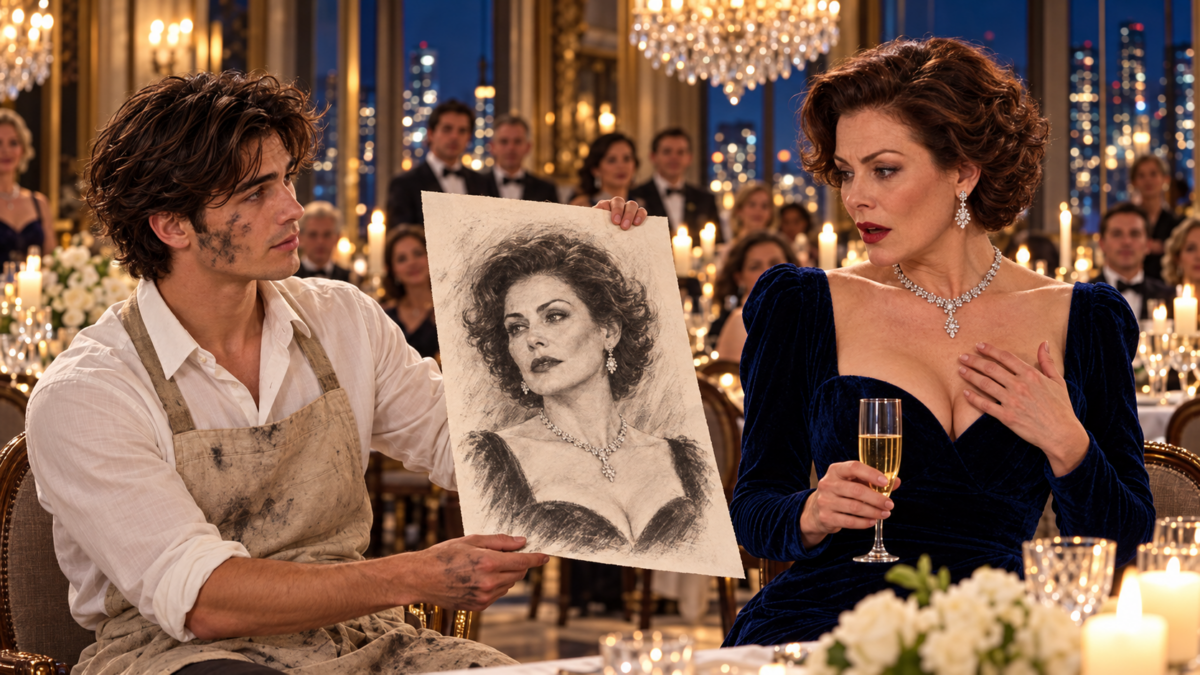
Under the crystal chandelier, Victoria held her champagne flute while the young artist worked. Beyond the windows, the city glittered. Behind her, dinner guests watched his charcoal move across the paper.
He wore a white shirt and a stained beige apron. A dark smudge marked his cheek. Victoria glanced from him to the grand portrait hanging on the wall, then smiled toward her guests.
“Well? Have you captured everything, or just the dress and diamonds?”
The artist looked up. “Everything. Even what you’ve been trying to hide.”
Her smile tightened. “And what exactly is that supposed to mean?”
He finished a line beneath the necklace, set down the charcoal, and raised the portrait.
“Look closely. You’ll understand.”
Victoria leaned forward. The face was hers, the jewelry familiar, the folds of the gown carefully shaded. Then she stopped breathing for a moment.
A line she remembered
There was no message hidden in the drawing. What she recognized was the way the artist had drawn the eyes: the lower lid left almost untouched, a narrow shadow beside it, a tiny break in the charcoal that made the expression seem alive.
Years earlier, she had watched another artist make that same choice. His name was Thomas Reed. He had painted her first commissioned portrait when she had little money and far fewer people to impress.
She looked toward the oil painting on the wall. It was the work her collection catalog credited to a celebrated society painter, Adrian Vale.
“Who taught you?” she asked the young man.
“My father. Thomas Reed.”
Her fingers tightened around the stem of the glass. “And your name?”
“Elias.”
The painting on the wall
Victoria asked the guests for a few minutes and set her glass down. Elias lowered the drawing carefully.
He had not accepted the evening’s commission by accident. He had recognized the oil portrait in a magazine photograph of her dining room. Among his father’s belongings were studies for it: the same chair, the same turned shoulder, the same necklace.
“I wrote to your office,” he said. “Twice. I was told the attribution had already been checked.”
Victoria remembered the inquiry. She had passed it to the dealer who had arranged the painting’s resale, then accepted his reassurance without asking to see the evidence.
“Your father sold it to me directly,” she admitted. “Later, the dealer said it could be cataloged under Vale. He said nobody would question it.”
Elias waited.
“I knew that wasn’t true,” she said. “I let the name stay because it made the collection sound more important.”
What he had brought with him
Elias opened his portfolio. Inside were dated sketches, a photograph of Thomas beside the unfinished canvas, and a copy of the original receipt bearing Victoria’s name.
Thomas had kept the records because he was proud of the commission. He had died before Elias found the published catalog and understood why his father’s painting had disappeared from his exhibition history.
“I’m not asking you to like my portrait,” Elias said. “I’m asking you to stop calling his work somebody else’s.”
Victoria studied the receipt. She could remember the little studio, the kettle on a shelf, and the care Thomas had taken wrapping the canvas. Those details had survived in her memory even while his name vanished from her wall.
“You’re right,” she said.
A correction that stayed on the record
That evening, Victoria told her guests that the painting had been wrongly attributed and that she had known its true origin. She did not describe it as a discovery she had made herself.
Over the following weeks, she arranged for an independent review of the records. With Elias’s permission, the corrected catalog included his father’s studies and the original commission details. A new label named Thomas Reed.
She paid Elias the agreed fee for the evening and offered to buy his charcoal portrait. He asked for time to decide.
“Of course,” she said. This time she did not treat the answer as an insult.
When the corrected catalog arrived, Elias placed a copy beside his father’s sketchbook. The public record now connected the painting to the man who had made it.
Victoria eventually received the charcoal portrait too. She hung it in her study, beneath a small label bearing Elias Reed’s name. Its expression was less flattering than the grand oil painting in the dining room, and she chose to keep it that way.