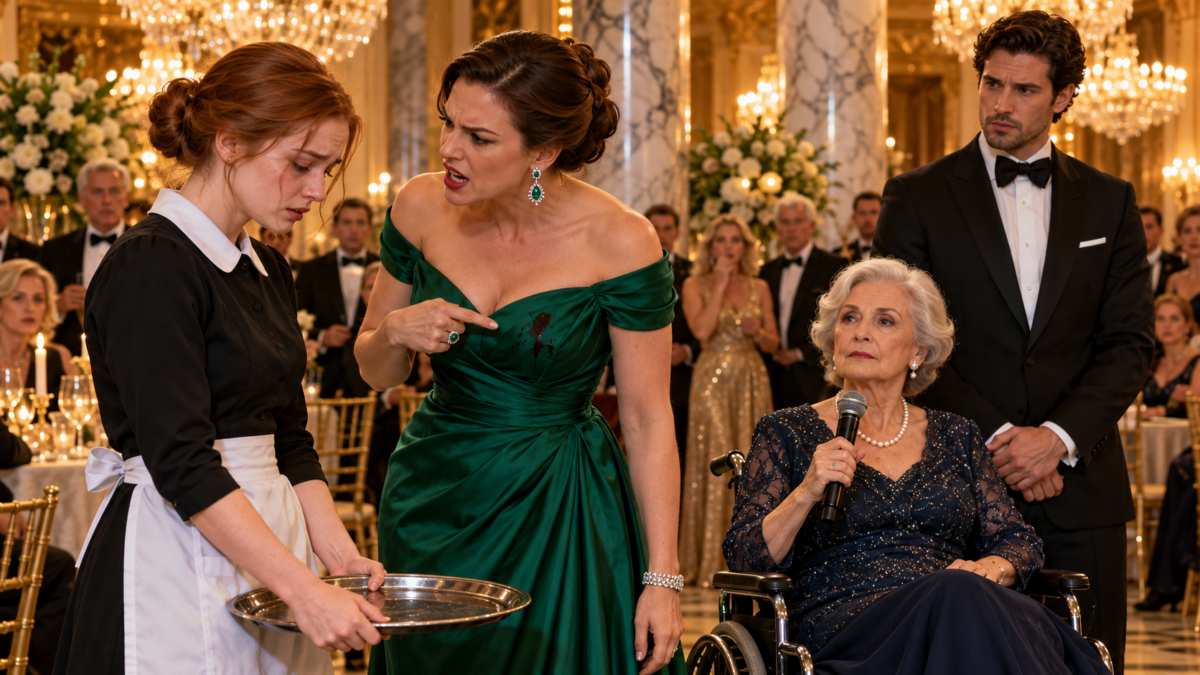
The first thing Clara heard was the glass breaking.
She turned toward the sound, still holding a tray of untouched champagne. At her feet, red wine spread across the marble floor. In front of her stood a woman in an emerald evening dress, staring at a dark stain near the hem.
For a moment, neither of them spoke.
Then the woman lifted her eyes.
“Do you have any idea what this dress cost?”
Clara glanced at the broken glass, then toward the crowded doorway. A guest had stepped backward into her arm as she passed between the tables. Everything had happened too quickly for her to catch the falling drink.
“I’m sorry,” she said. “Let me get someone to help with the stain.”
“Someone?” the woman repeated. “You’re standing right here.”
Nearby conversations began to fade.
Clara set her tray on an empty table.
“I’ll bring a clean cloth.”
She started toward the service entrance, but the woman caught her wrist.
“You don’t get to walk away while I’m speaking.”
The Guest Everyone Wanted to Please
The woman’s name was Victoria Hale.
Clara knew it because the staff had been reminded twice before the gala began: Victoria was engaged to Adrian Whitmore, grandson of the woman whose foundation was hosting the evening.
Be attentive. Be discreet. Make sure her table has everything it needs.
Clara had followed those instructions. She had found a different chair when Victoria disliked the first one. She had replaced a glass that Victoria said was cloudy. She had gone to the kitchen for a dish that was not on the menu.
Now Victoria’s fingers tightened around her wrist.
“Please let go,” Clara said quietly.
Victoria released her with a short, dismissive movement.
Across the room, Adrian turned from a conversation with two donors. He saw the broken glass first, then Clara rubbing her wrist.
“What happened?”
Victoria immediately stepped toward him.
“She spilled wine over me. I asked her to take responsibility, and she became rude.”
Adrian looked at Clara.
“Is that what happened?”
Before she could answer, Victoria spoke again.
“Honestly, Adrian. Look at my dress.”
“I can see your dress,” he said. “I’m asking her.”
Clara swallowed.
“Someone bumped my arm. I apologized and offered to get help.”
“And then?”
Clara hesitated. Around them, guests watched with the uncomfortable stillness of people hoping someone else would intervene.
“She asked me to stay,” Clara said.
Adrian noticed the red marks on her wrist.
A Quiet Voice Behind Them
“Clara.”
The voice came from beside the tall windows.
An older woman sat in a wheelchair, a pearl necklace resting against her pale evening dress. Until then, she had been listening without speaking.
It was Eleanor Whitmore.
Clara straightened.
“Yes, Mrs. Whitmore?”
“Would you come here, please?”
Victoria stepped aside, visibly relieved.
“I’m sorry this has disturbed your evening, Eleanor. I’m sure the manager can handle—”
“I asked Clara to come here.”
Clara walked over and knelt slightly so Eleanor would not have to look up at her.
“Are you hurt?” Eleanor asked.
“No, ma’am.”
Eleanor glanced at her wrist, but did not challenge the answer.
“Did you eat before your shift?”
The unexpected question made Clara blink.
“Yes.”
Eleanor waited.
“Half a sandwich,” Clara admitted.
“Adrian, ask the kitchen to prepare a proper meal. And please bring Mr. Bennett.”
Mr. Bennett was the event manager.
Victoria folded her arms.
“Surely we don’t need to involve everyone over a spilled drink.”
Eleanor looked at her.
“We didn’t.”
The Reason Clara Was Working That Night
When the manager arrived, Clara’s face tightened.
“Mrs. Whitmore, please. I need this job.”
Eleanor reached for her hand.
“Why do you think you’re losing it?”
Clara glanced toward Victoria, then lowered her eyes.
There was enough in that small movement to make Adrian turn away from his fiancée.
Eleanor addressed the manager.
“Has there been any complaint about Clara’s work?”
“No, Mrs. Whitmore. Quite the opposite.”
“Then please make sure tonight’s accident is recorded accurately.”
He nodded.
Only after he left did Eleanor ask Clara whether she was still attending college.
“You remembered?”
“Your scholarship letter is on my desk.”
Clara stared at her.
Months earlier, she had applied to the foundation’s hospitality scholarship program. She had written about leaving college when her mother became ill, working evenings, and hoping to finish her qualification when she could afford the remaining fees.
She had received an acknowledgment, then nothing.
“I thought I hadn’t been selected.”
“The committee hasn’t announced the recipients yet,” Eleanor said. “But I read the applications.”
Victoria gave a small, impatient laugh.
“So this is a scholarship interview now?”
“No,” Eleanor replied. “It’s a conversation you keep interrupting.”
What Eleanor Had Seen
Adrian pulled a chair beside his grandmother.
“Did you see what happened?”
“Yes.”
Victoria’s expression changed.
Eleanor continued before she could speak.
“I saw a guest step into Clara’s path. I saw the glass fall. I heard an apology.”
She paused.
“And I saw Victoria hold her wrist when she tried to fetch a cloth.”
“It wasn’t like that,” Victoria said. “I was upset.”
“I know you were.”
“You’re making me sound cruel over one bad moment.”
Adrian looked at her for a long time.
“Then apologize.”
Victoria turned toward Clara.
“I’m sorry the situation got out of hand.”
Adrian shook his head.
“That isn’t what I meant.”
Color rose in Victoria’s face.
For several seconds, the only sound nearby was a waiter gathering the last pieces of broken glass.
Finally, Victoria picked up her evening bag.
“I won’t stand here and be judged by everyone.”
She walked toward the entrance. Adrian did not follow.
The Woman in the Wheelchair Asked for the Microphone
A few minutes later, the host approached Eleanor to ask whether she still wished to give her scheduled remarks.
“Yes,” she said. “Bring me the microphone.”
Clara had already started toward the kitchen when Eleanor began speaking.
“Before we continue, I’d like to thank the people working tonight.”
Around the ballroom, members of the service team stopped briefly beside their tables.
“This evening raises money for education and opportunity. Some of the people serving our dinner are studying after their shifts. Some are caring for relatives. Some are saving enough to return to the classrooms they had to leave.”
Eleanor glanced toward Clara, then back at the guests.
“They deserve our courtesy without having to explain any of that.”
She thanked the kitchen staff, the cleaners, the musicians, and the event team by name where she could. Then she returned to her prepared speech.
There was no dramatic announcement. Clara was not called onto the stage or asked to recount what had happened.
For that, she was grateful.
She ate a warm meal in the staff room, washed her face, and finished her shift.
An Apology Without an Audience
Adrian waited near the service entrance after the gala.
When Clara emerged carrying her coat, he stood.
“I wanted to apologize.”
“You didn’t spill the drink.”
“No. But you were afraid you’d lose your job because of someone connected to my family.”
Clara adjusted the strap of her bag.
“Would I have?”
“You shouldn’t have had to wonder.”
She considered that answer, then nodded.
He offered to arrange a car, but she told him her colleague was giving her a lift.
Before leaving, she looked back.
“Please thank your grandmother for the dinner.”
“I will.”
“And for not making me stand up there.”
Adrian smiled faintly.
“She thought you might say that.”
The Letter That Arrived Three Weeks Later
Clara received the scholarship decision on a rainy Tuesday morning.
She read the email twice before calling her mother.
She had been selected.
The award covered her remaining tuition and included a paid placement at a hotel participating in the foundation’s training program. The letter explained that recipients had been chosen using the committee’s published criteria.
Attached was a short note from Eleanor.
Your application was strong before we met at the gala. I hope you enjoy finishing what you started.
Clara printed both pages.
The formal letter went into a folder with her college documents. The note stayed on the small desk beside her bed.
Adrian ended his engagement to Victoria that same month. There were other conversations, away from the ballroom, and other problems they had avoided discussing. What happened at the gala made those conversations impossible to postpone.
Clara heard about it through a colleague. By then, she was busy arranging her class schedule.
A Different Evening
A year later, Clara returned to the foundation’s annual gala.
This time, she attended as one of several scholarship recipients invited to speak about their studies. She wore a simple navy dress and carried a short speech folded inside her bag.
Eleanor greeted her near the windows.
“How is your mother?”
“Much better.”
“And college?”
“One final assessment left.”
Before Clara could say more, a young server approached with a tray of sparkling water. As a guest moved past, one glass tipped, splashing Clara’s sleeve.
The server went pale.
“I’m so sorry.”
Clara caught the glass before it fell.
“It’s all right,” she said, setting it upright. “Could you point me toward the washroom?”
The young woman gave her directions and hurried away for a cloth.
Clara turned back to Eleanor, who was watching her with a small smile.
“What?” Clara asked.
“Nothing,” Eleanor said. “Go dry your sleeve. You’re speaking in ten minutes.”
Clara laughed and headed across the ballroom.
This time, when people turned to look at her, she had something she wanted to say.