A fictional drama. Read the complete story and ending below.
“I think you can move your foot.”
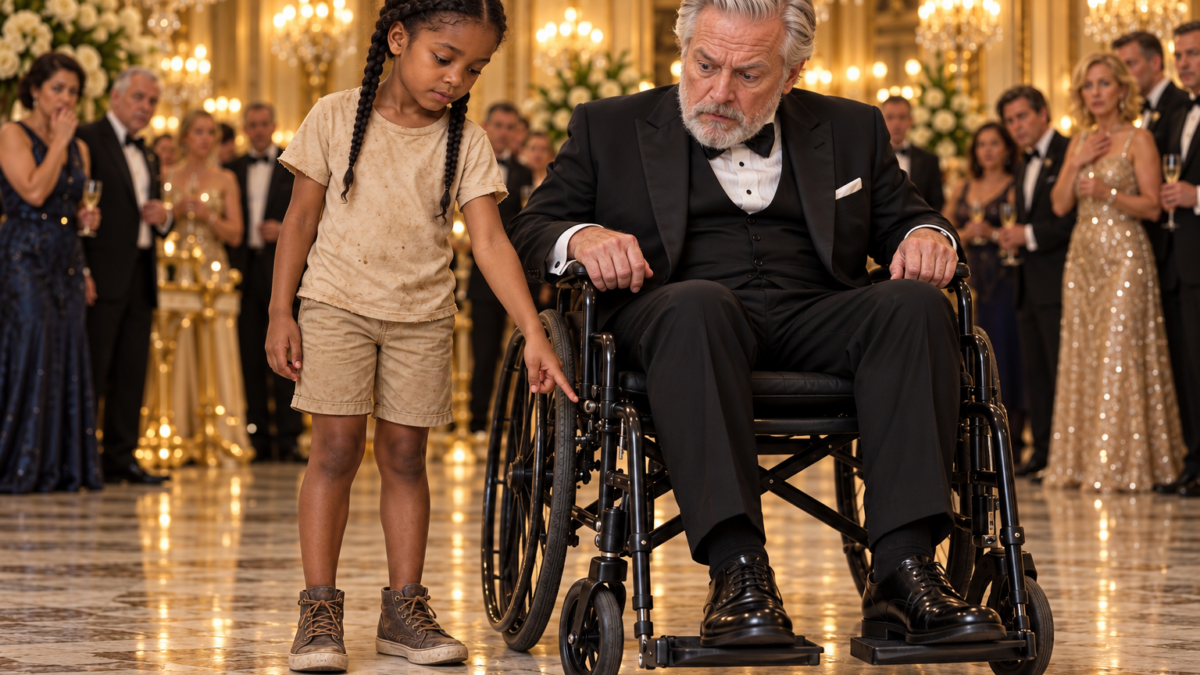
The little girl’s voice carried farther than she intended. Beneath the ballroom’s crystal chandeliers, several guests turned toward the older man in the wheelchair. His silver beard barely moved as he pressed his lips together.
“And what makes you think that?”
She wore a faded beige shirt, khaki shorts, and battered brown shoes. Her two braids rested against her shoulders. Around her, silk dresses brushed the marble floor.
“Because I saw it move. You don’t have to stand up. Just look down.”
She lowered her raised finger and opened her hand, palm upward. She did not reach for him or touch his chair.
“You don’t have to prove anything to them. Just try once… for yourself.”
Arthur tightened his grip on the armrests. For a moment, he wanted to tell someone to take the child away. He had come to the foundation’s dinner to make a donation, not to become the evening’s entertainment.
Then she pointed toward his shoes.
“There. Did you feel that?”
The smallest movement
Arthur looked down. His right shoe seemed to have shifted against the edge of its footplate. He held his breath and tried again.
Nothing happened.
The room remained silent. Someone behind him whispered, but the girl kept her eyes on his face.
“It’s okay,” she said softly. “You don’t have to do it again for everybody.”
That was what surprised him most. She had noticed his embarrassment before anyone else had noticed the movement.
Arthur had used a wheelchair since an accident two years earlier. His recovery had brought uncertain changes, difficult appointments, and long stretches without anything he could recognize as progress. Tonight’s tiny sensation could mean several things. It was not an answer, and it certainly was not a reason to stand.
He released one armrest. “What’s your name?”
“Maya.”
“Who are you here with, Maya?”
She glanced toward the service doors. “My mom. She’s helping with dinner.”
The woman at the doorway
A woman in a catering uniform hurried toward them, her expression changing when she saw the circle of guests.
“Maya, I asked you to stay near the kitchen.” She stopped beside her daughter. “I’m sorry, sir. Our sitter canceled. My supervisor said she could wait in the staff room.”
Arthur shook his head. “She hasn’t hurt anyone.”
“I saw his shoe move,” Maya explained. “Like Grandma’s hand, when she was practicing.”
Her mother, Elena, closed her eyes briefly. “Sweetheart, everyone’s situation is different.”
“I know. I just thought he might want to see.”
Arthur looked at the waiting crowd. He knew most of their names. They had praised his resilience, offered advice he had never requested, and sometimes spoken to the person pushing his chair instead of speaking to him.
The child had simply asked him to look.
“Would you give us a little room?” he asked the guests.
Conversations slowly resumed. The circle opened. For the first time that evening, he could breathe without feeling watched.
What he really felt
“Did it move?” Elena asked quietly.
“I think so,” Arthur said. “And I felt something. I’ll tell my therapist.”
He did not try to get out of the chair. He did not make a speech about miracles. Instead, he asked an assistant for his phone and recorded a short note describing what he had noticed, so he could discuss it at his next appointment.
Then he turned back to Maya.
“You were right about one thing.”
She waited.
“I didn’t have to prove anything to them.”
Maya smiled. “Grandma says people practice better when nobody’s making a face.”
Arthur laughed, a small startled sound that made Elena smile too.
He asked whether Maya had eaten. Elena explained that their meals were waiting in the staff room. He thanked her for telling him and asked the event manager to make sure staff had time for their scheduled break. Elena returned to work, and Maya went with her after waving goodbye.
The ending
At his next rehabilitation appointment, Arthur described the sensation and the possible movement. His clinician checked it carefully and adjusted what they would monitor during his existing program. There was no promise of walking and no sudden transformation. His wheelchair remained an important part of his life.
But something about the dinner stayed with him.
For months, he had treated every exercise as a performance he was failing in front of an invisible audience. Maya’s words gave him a different reason to try: his own comfort, independence, and curiosity about what might be possible.
Several weeks later, the foundation held a smaller community lunch. Elena was working that afternoon. Maya sat at the staff table with a coloring book when Arthur arrived.
He was still in his wheelchair.
“Did you do it again?” she asked.
“A little,” he said. “Sometimes. We’re taking our time.”
She nodded as though that were a perfectly good ending.
Arthur handed her a note, with Elena standing beside her. Inside, in his own uneven handwriting, were eight words:
Thank you for speaking to me, not the room.
“You counted wrong,” Maya said after studying it. “That’s ten.”
He looked at the note, then laughed again. “Then I suppose I still have something to practice.”
The smallest movement that night had belonged to his foot. The change that mattered most was that he had stopped measuring his worth by who was watching.