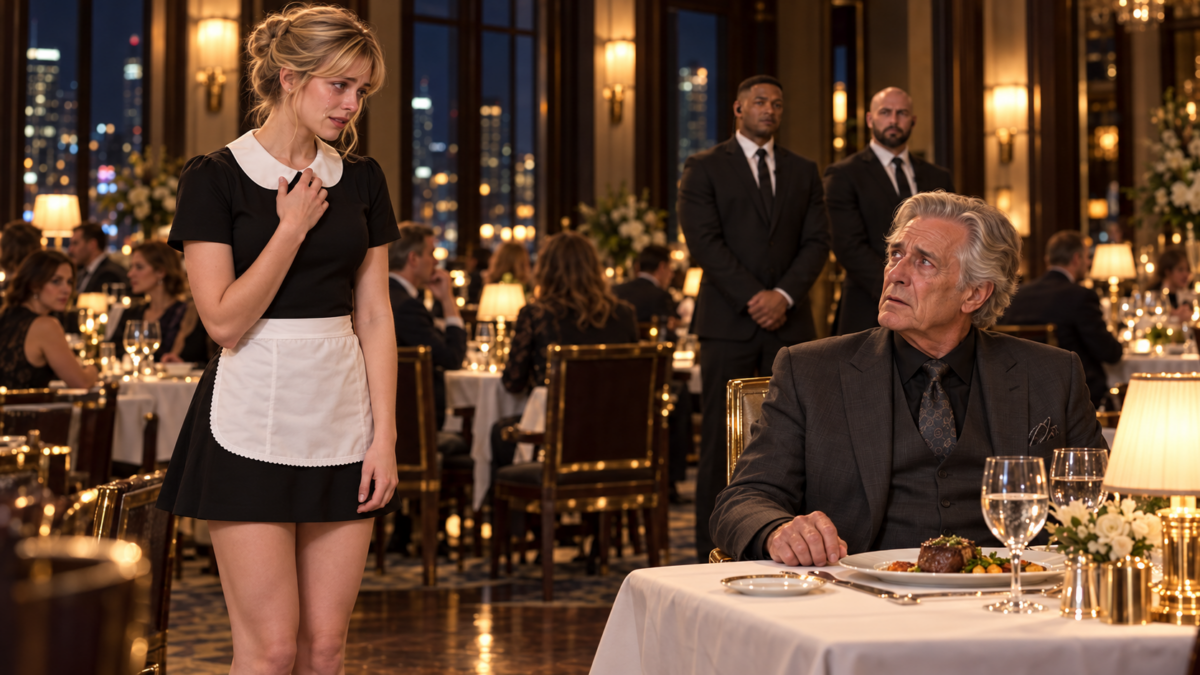
A fictional drama.
Lucy Bennett barely realized she was humming.
It was something she did when the restaurant grew busy—a few quiet notes beneath the clink of glasses, a melody her mother had sung whenever the world felt too loud.
She placed the dinner plate on the white tablecloth and withdrew her hands.
Before she could step away, the silver-haired man at the table looked up.
“Who taught you that song?”
His voice was low, but the question stopped her.
“My mother,” Lucy answered. “She sang it when I was scared.”
Saying it aloud caught her off guard. Her mother had been gone less than a year. Sometimes Lucy could mention her without difficulty. Other times, a familiar sound was enough to undo an entire evening’s composure.
She touched her chest and tried to steady her breathing.
Near the hallway, two men in dark suits began approaching.
The customer raised an open palm.
“Give us a minute.”
They stopped.
He turned back to Lucy, his expression softer now.
“What was your mother’s name?”
“Rose Bennett,” she said. A tear slipped down her cheek. “She died last winter.”
The man’s hand trembled beside his untouched plate.
For several seconds, he said nothing.
Lucy watched the color drain from his face.
“How do you know my mother?”
The next line of the song
He looked down at the tablecloth.
Then, almost too quietly for her to hear, he spoke.
“When the window fills with rain…”
Lucy went still.
She knew what followed.
“…I will sing you home again.”
Her mother had sung those words in dark bedrooms, during thunderstorms, beside hospital beds.
Lucy had never heard anyone else say them.
“Where did you hear that?”
The man lifted his eyes.
“I made it up for my daughter.”
Lucy’s hand fell from her chest.
“My name is Edward Hayes,” he continued. “My daughter’s name was Rose.”
Around them, dinner carried on. A server passed with a tray. Someone laughed at another table.
Lucy felt as though the room had moved far away.
“My mother said her father wasn’t part of her life.”
Edward nodded slowly.
“That was true.”
The photograph on her phone
He did not reach for her or ask her to call him anything.
Instead, he asked whether she would feel comfortable showing him a photograph.
Lucy hesitated, then took out her phone.
She found a picture from the previous summer: Rose standing outside their apartment, laughing because Lucy had insisted on photographing the flowers she had grown in mismatched pots.
Edward stared at the screen.
His mouth tightened.
“She still tilted her head when she laughed.”
Lucy looked at the photograph again.
It was such a small observation. Her mother did exactly that.
Edward turned slightly away and pressed a handkerchief against his eyes.
Lucy’s manager had noticed the conversation by then. She approached discreetly, and Lucy asked for a short break.
A few minutes later, they moved to a quiet table near the closed lounge. Edward asked his security staff to wait outside.
Lucy kept her phone in her hand.
“Tell me what happened,” she said.
The sentence he could not take back
Twenty-seven years earlier, Rose had told her father she intended to marry Michael Bennett.
Edward had objected.
Michael worked with his hands. He had little money, no connections, and plans Edward considered uncertain. Rose had listened to her father’s objections until he began speaking about Michael as though he were an embarrassment she would eventually outgrow.
Then she had stood up.
Edward remembered her coat over one arm.
He remembered saying the sentence before he had decided whether he meant it.
“If you walk out with him, don’t come back.”
Rose had waited a moment.
Then she had left.
Lucy looked at him without speaking.
“I was cruel,” Edward said. “There isn’t a kinder way to describe it.”
“Did you ever apologize?”
“I tried to contact her through my brother, Arthur. He knew where she was staying after she moved.”
Edward explained that Arthur had offered to carry messages between them.
At first, Edward had been told Rose needed time. Later, Arthur said she wanted no contact.
Edward had written a letter. Arthur said she had returned it unopened.
Eventually, Edward had stopped asking.
Lucy’s expression hardened.
“You stopped.”
“Yes.”
“Even though you could have tried another way.”
Edward lowered his head.
“Yes.”
What Rose had been told
Lucy remembered a different version of those years.
Her mother had said she wrote to her father after getting married. Later, she wrote again when Lucy was born.
There had been no reply.
Once, Rose had received a message through her uncle.
Her father still refused to accept the family she had chosen.
“She kept the letters,” Lucy said.
Edward looked up.
“The ones she wrote?”
“Copies. And some envelopes that came back.”
For the first time that evening, something beyond grief crossed his face.
He asked whether she would be willing to let him see them.
Lucy put her phone away.
“I’m not bringing you everything tonight.”
“Of course.”
“And I don’t know you.”
“I understand.”
She studied him for a moment.
Then she agreed to meet him again, in a public place, after she had spoken to her aunt.
The letters in the blue box
Three days later, Lucy arrived at a café with her aunt and a small blue storage box.
Inside were photographs, photocopied letters, and envelopes Rose had saved through several moves.
Edward brought the correspondence he had kept.
The dates told a story neither of them had expected.
Rose had been writing during the same months Edward was being told she wanted nothing to do with him.
His own letters had never reached her.
One envelope addressed to Edward had been returned with a short note in Arthur’s handwriting, claiming to speak on his behalf.
Lucy’s aunt recognized it immediately.
“That’s the message Rose showed me.”
Edward read it twice.
He had never authorized it.
With their permission, an independent adviser reviewed the records and helped arrange a conversation with Arthur.
Confronted with the documents, Arthur eventually admitted he had withheld messages.
He had wanted Edward dependent on him in the family business. A reconciliation with Rose—and the possibility that she might return to work with her father—had threatened the influence he had gained.
He had used their anger to keep them apart.
Edward ended Arthur’s authority in his affairs and arranged a separate review of the business records.
But when he told Lucy what had happened, he did not present it as an excuse.
“Arthur lied,” he said. “I still chose to believe him without going to your mother myself.”
A name was not enough
Over the following weeks, family records and a DNA test confirmed their relationship.
Lucy was Edward’s granddaughter.
The confirmation brought tears. It did not bring back the years.
At one meeting, Edward asked what Rose’s life had been like.
Lucy told him about her parents’ small apartment, her father’s workshop, the secondhand piano her mother had loved.
Michael had died several years before Rose. After that, mother and daughter had looked after each other.
“We didn’t have much,” Lucy said. “But she made our home feel safe.”
Edward listened.
“Was she happy?”
“Sometimes. A lot of the time.”
Lucy paused.
“She could be happy and still miss you.”
He nodded, unable to answer.
Then Lucy said something she had been carrying since the restaurant.
“I can decide whether I want to know you. I can’t forgive you for her.”
“I won’t ask you to.”
His first request
Edward did not ask Lucy to leave her job or move into his house.
He asked whether she would take him to Rose’s grave.
Lucy agreed.
They went on a cold Sunday morning.
Edward carried a simple bunch of flowers and a letter he had written himself. He had rewritten it several times before realizing there was no version that could make his absence smaller.
At the grave, he stood quietly.
Then he read the letter aloud.
He apologized for the words at the doorway.
For trusting someone else to tell him what his daughter felt.
For allowing shame and pride to become silence.
Lucy stood a few steps away, giving him room.
When his voice broke, he stopped.
She waited.
A beginning that belonged to Lucy
Afterward, they walked toward the cemetery gate.
Edward asked whether he could call her the following week.
“Sunday afternoon,” Lucy said. “I’m working Saturday.”
He took out a small notebook and wrote it down.
It was an ordinary answer. A day and a time.
For Lucy, that mattered more than a promise that everything would be different.
As they reached the gate, a light rain began.
Without thinking, she hummed the melody her mother had taught her.
Edward stopped walking.
Lucy glanced at him, then continued softly.
This time, he stayed until the song was finished.