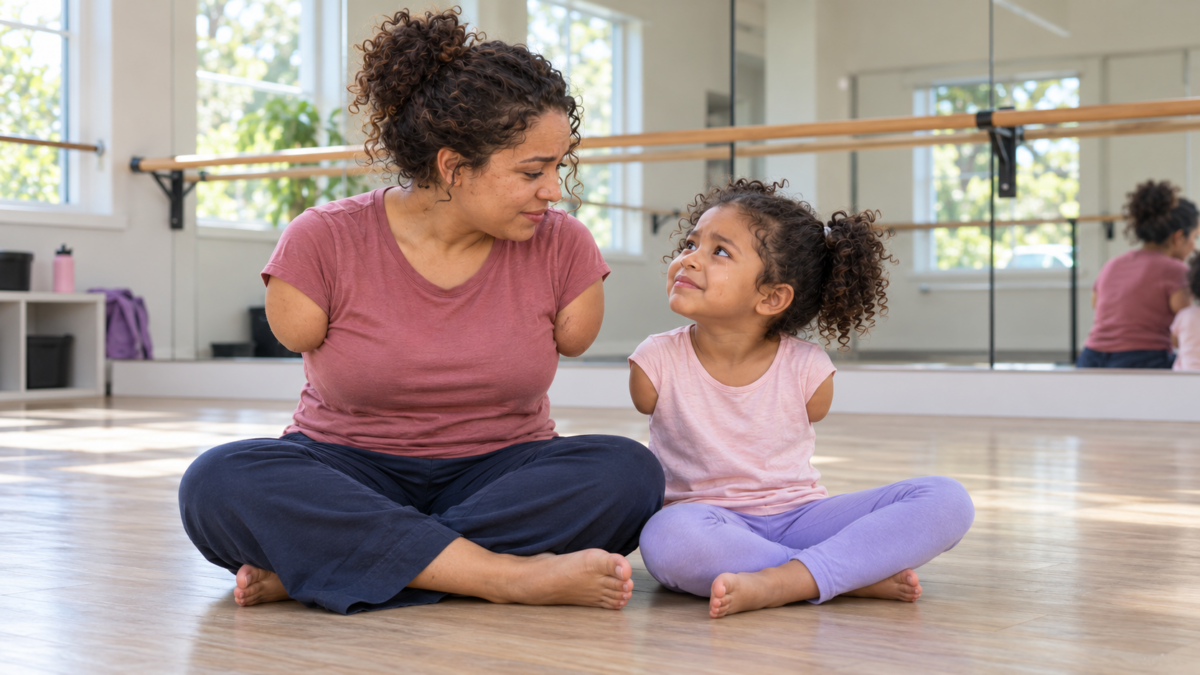
“Then why did they say I couldn’t dance?”
Mia stopped smiling.
A moment earlier, her daughter had been laughing beside her on the studio floor. Now Ella’s eyes were filling with tears.
Mia leaned closer.
“Who said that, sweetheart?”
Ella looked down at her lavender leggings.
“The girls by the shoe shelf.”
The afternoon had been full of small victories. Suddenly, Mia understood why none of them had quite convinced her daughter.
One small movement
They had stayed after class to practice.
Sunlight stretched across the wooden floor. Somewhere down the hall, another teacher was putting away a speaker.
Ella sat facing her mother and tried to lift one leg.
She wobbled, lowered her foot, and looked away.
“Mommy… I can’t do it.”
Mia had heard those words before—over stubborn clothing, unfamiliar pencils, and games that moved faster than Ella could follow.
Sometimes her daughter needed help. Sometimes she needed a break.
That afternoon, Mia offered another attempt.
“Not yet. Let’s try together.”
She demonstrated a small movement, slowly enough for Ella to watch.
Ella lifted her foot again.
“Like this?”
“Just like that.”
Her daughter’s smile returned.
For a few seconds, Mia thought the difficult part of the day was over.
The things they did at home
At home, Ella rarely waited for someone to tell her what she could try.
She and Mia both had upper-limb differences. Their rooms were arranged around the ways they moved and used their feet.
Colored pencils stayed in a shallow tray beside a low drawing surface. Clothing had familiar places. Tasks that visitors sometimes found surprising were simply part of the family’s routine.
The previous evening, Ella had colored beside her mother.
She had paused to inspect Mia’s drawing.
“Your flower is bigger.”
“It’s a very ambitious flower.”
Ella had giggled and added another purple petal to her own.
Later, she had insisted on giving Mia a makeover. Holding a soft brush carefully between her toes, she had dabbed her mother’s cheek.
“How do I look?” Mia asked.
“Beautiful.”
Mia had laughed.
Now, on the studio floor, she remembered how certain Ella had sounded.
She wished her daughter felt that certain about herself.
What happened by the shoe shelf
Mia waited while Ella found the words.
Two children had been talking about the upcoming class performance.
Ella had said she wanted to stand beside them.
One had asked how she would do the part where everyone joined hands. The other had told her she probably couldn’t be in the dance.
“Did your teacher hear?” Mia asked.
Ella shook her head.
“Did anyone tell you that you weren’t allowed to perform?”
“Not the teacher.”
Mia took a slow breath.
The distinction mattered. So did the hurt on her daughter’s face.
“Did you want to ask her about it?”
Ella’s voice became smaller.
“I didn’t want her to say it too.”
Mia stayed beside her until Ella looked up.
“We can ask together,” she said. “And you can tell me if you want to stop.”
A conversation before the next class
Mia contacted the teacher that evening.
She explained what Ella had heard and asked how the performance was being planned.
The teacher, Ms. Parker, called her back.
“I’m glad you told me,” she said. “I hadn’t heard that conversation.”
She explained that the routine was still being developed. One section involved partners joining hands and moving in a circle.
They had not yet worked through an alternative with Ella.
Mia listened.
“Ella saw the others practicing it,” she said. “She needs to know where she belongs in the routine before she starts assuming there isn’t a place.”
Ms. Parker agreed to meet them before the next lesson.
Mia asked Ella whether she wanted to come.
“Will I have to dance by myself?”
“We’ll talk about that first.”
Ella thought for a moment.
“Okay.”
The question nobody had asked her
At their meeting, Ms. Parker sat on the floor with them.
“I heard something happened that made you feel you couldn’t be in the performance.”
Ella nodded.
“I’m sorry you were left feeling that way.”
The teacher showed her the section of the dance that was causing concern.
Then she asked:
“What would feel comfortable for you here?”
Ella looked toward Mia.
Her mother waited.
After a while, Ella pointed with her foot toward a spot on the floor.
“Could we turn without holding hands?”
Ms. Parker stood and tried the movement.
Then she tried it again with more space between the dancers.
“Yes,” she said. “Let’s see how that works with the music.”
Ella watched carefully.
“Everybody?”
“We can try it with everybody.”
A place beside the others
At the next class, Ms. Parker explained the revised movement to the group.
The children practiced turning beside their partners, following the same musical cue.
They missed the timing.
They laughed.
They tried again.
Ella missed it too.
For once, she did not look toward the door.
When the class paused for water, one of the children from the shoe shelf approached her.
“I shouldn’t have said you couldn’t do it.”
Ella studied the floor.
“No.”
The child hesitated.
“Do you still want to be next to me?”
Ella glanced toward the practice marks.
“On that side.”
“Okay.”
Mia watched from her chair without interrupting.
There was no sudden friendship to announce. There was another attempt, made with a little more care.
The afternoon Ella wanted to stay
Over the following weeks, some rehearsals went well.
Others ended with tired feet and frustration.
Ella still sometimes said, “I can’t do it.”
Mia stopped treating every use of those words as the same problem.
Sometimes the music was too fast.
Sometimes Ella had forgotten the sequence.
Sometimes she simply wanted to go home.
They learned to ask what was difficult before deciding what to try next.
One afternoon, class ended and Ella remained beside her floor marker.
“Can we do it once more?”
Ms. Parker checked the time.
“One more.”
Ella turned toward her mother.
“Are you watching?”
“Yes.”
“The whole thing?”
“The whole thing.”
Her own place on the floor
On the day of the small class performance, Mia sat among the other families.
Ella found her in the audience and smiled.
The music began.
The children stepped, turned, and briefly lost their places.
Ella looked toward her partner. They found the next count together.
At the section she had once feared, the group turned without joining hands.
No one stopped.
Afterward, Ella came over, breathing quickly.
“Did you see?”
“I saw.”
“I was early on the turn.”
“A little.”
Ella considered that.
“Next time, I’ll wait.”
Mia smiled.
“Next time?”
Her daughter looked back toward the other children.
Then she nodded.